




More News
- Intelligent Welding Robots Drive the Upgrade of Manufacturing in India
- What industry applications require real-time thermal distortion compensation in H-beam welding machines for EN 1090-2 EXC3 execution class?
- Which H-beam welding machine model delivers lower TCO over 5 years when welding AS/NZS 1554.1 Class 4 joints in Australian mining fabrication shops?
- How long does it take to ship an H-beam welding machine with dual-axis CNC torch height control from Shanghai to Rotterdam port under current IMO Tier III emission compliance requirements?
- Why does customer support for H-beam welding machines rarely resolve issues with mismatched IGBT pulse timing and AWS D1.1 Clause 5.21 preheat validation?
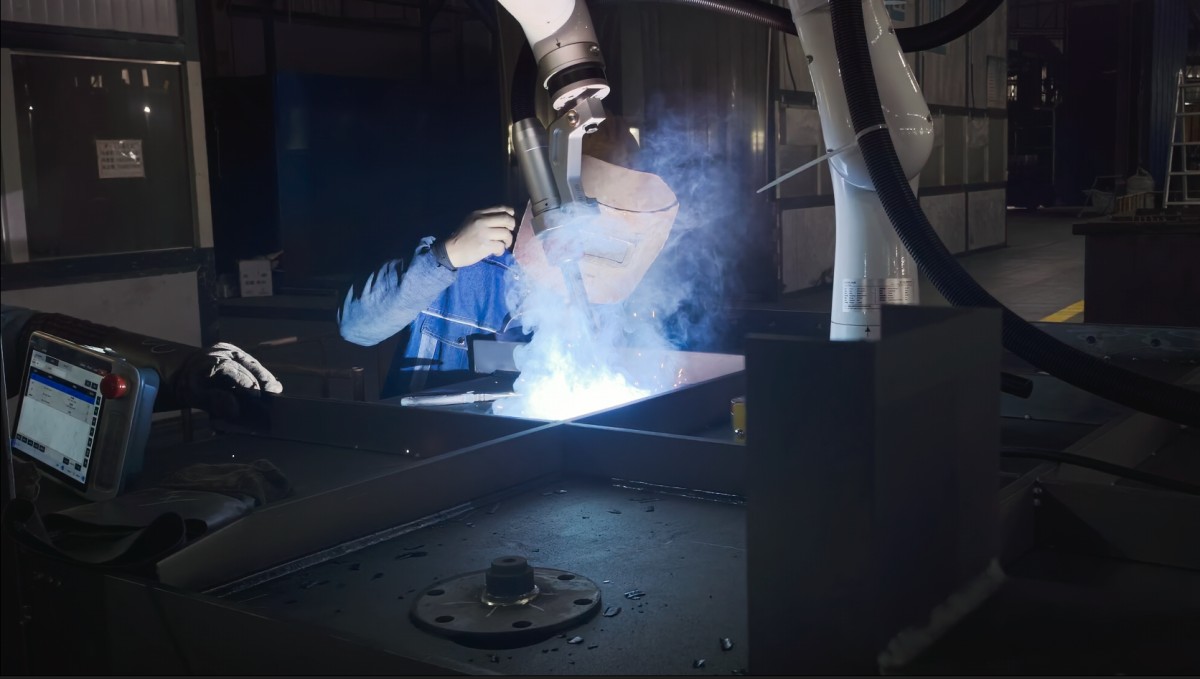
Cobots have proven to be a popular choice for small to medium-sized job shops. They are designed to be easy to program and can be redeployed elsewhere, if needed.
Walk into almost any fab shop today and you’ll hear the same story: “We can’t find enough welders. Production is backed up, and customers want parts yesterday.”
Labor shortages, tighter timelines, and ever-stricter quality demands are pushing shops to look for answers beyond adding another shift. For many, the buzzword solution is automation—specifically, robotic welding.
The good news? Robots are no longer reserved for the giant OEMs with endless floor space and million-dollar budgets. Compact, more affordable cells are opening the door for small and medium-sized shops to bring robotic welding in-house. The catch? Just because the technology is accessible doesn’t mean every shop is ready to jump in.
So how do you know if a robotic arc welding cell makes sense for your operation? Let’s break it down.
The Benefits of Automation
When shops talk about why they’re considering automation, three themes always surface:
1. Efficiency and speed - A skilled welder might average a small fraction of an inch per second on repetitive joints, depending on fatigue and focus. A robotic cell can double or triple that pace—and it never slows down at the end of a long shift.
2. Consistency and quality - Even the best welders have off days. Robots don’t. Automation takes human variability out of the equation, delivering smoother seams, less spatter, and less rework. Many shops find they can cut back drastically on grinding and polishing because the welds are clean right off the robot.
3. Labor costs and smarter staffing - With skilled welders hard to find, automation allows shops to redeploy talent into higher-value work. Instead of burning hours on repetitive welds, experienced workers can focus on programming, fixture setup, or mentoring apprentices. The robot handles the monotonous jobs, while people handle the craftsmanship and decision-making that still require a human touch.
Assessing Your Shop’s Needs
Before you sign off on an automation investment, take a hard look at how your shop runs today and where it’s headed. When investigating automation, you should consider your production volume, project mix, and workforce readiness, as well as available space, supporting utilities, and safety considerations.
Production Volume. Automation makes the most sense when there’s enough repetition to justify programming and fixturing. That doesn’t necessarily mean high volume. Collaborative robots, or cobots, are especially strong in high-mix, low-volume environments where jobs change frequently. They’re quick to program, flexible to redeploy, and still capable of handling longer production runs when paired with the right fixtures.
Type of Projects. The kind of work you handle is still an important factor in whether robotic arc welding makes sense at your shop, but new technology is changing the decision process. In the past, automation was seen as something useful only for large, repetitive jobs. But with today’s technology, robotic welding can handle both thin-gauge sheet metal and heavy plate.
Robotic welding cells also are forgiving of small part-to-part variations. They don’t demand perfect fit-up, which makes them well-suited for shops where upstream processes like cutting and bending aren’t always dialed in to the thousandth of an inch. That flexibility allows shops to automate a wide range of projects—from short runs to larger batches—without being locked into ultratight tolerances.
Workforce Considerations. Automated welding systems with cobots reduce the barriers to entry. Using point-to-point programming, the operator physically guides the robot to each weld start and stop, almost like leading a partner through a dance. This hands-on approach makes the technology less intimidating and puts automation within reach for shops that don’t have robotics engineers on staff.
System Requirements and Considerations. Once you’ve nailed down your production volume, project mix, and workforce readiness, the next step is installation. Will your shop’s space, safety requirements, and utilities support the robot you want to buy?

Teaching a cobot a welding path doesn’t have to take the better part of a day like it used to with older robotic weld cells.
Some systems arrive as turnkey solutions, complete with built-in fume extraction, guarding, and safety features. They’re essentially plug-and-play and take the compliance guesswork off your plate. On the other end are stripped-down, open-table robots. They cost less upfront, but there’s a trade-off. Without enclosures, robot speed is capped by safety regulations, which limits throughput.
In a fully enclosed robotic cell with proximity switches and interlocked doors, the robot can run at full speed while keeping operators safe. Enclosures also allow for features like top-loading with an overhead crane, dual-station setups for continuous production runs, and clear operator access points for loading and unloading.
In terms of utility requirements, welding robots are pretty forgiving. They just require power, compressed air, inert gas, and fume extraction. No exotic plumbing or chillers are required in most shops.
Factors Influencing Return on Investment
For many shop owners, the real question isn’t how much the robot costs but how quickly it starts paying for itself. With robotic welding, ROI usually comes from reducing labor hours and eliminating costly inconsistencies.
A robot delivers steady, predictable production. That predictability often proves just as valuable as any labor savings. The shop has a workflow that can be counted on day after day.
Integration with Existing Processes
Buying a robot is easy. Making it fit into your workflow is harder.
Welding cells tend to be more forgiving than other automation processes. They can handle joints that aren’t perfectly prepped and still deliver good results.
Once the machine is set up and programmed, day-to-day operation becomes straightforward. In many cases, a less-skilled operator can load and unload parts, essentially pushing a button to keep the cell running.
Experienced welders now are able to focus on custom assemblies, precision welds, or process improvement tasks. This shift doesn’t just boost productivity; it also helps with morale. Welders are more likely to stick around when their day-to-day work is stimulating, varied, and engaging.
Additional Safety Considerations
Safety is nonnegotiable in any welding process, and automation adds new requirements.
Robotic welding cells typically include barriers, fume extraction, and light curtains. Operators still need PPE, but the enclosure helps reduce exposure.
Regardless of the system you choose, training is critical. A safe cell is only as safe as the people using it. Operators need to be trained not just how to run the system, but also how to recognize and avoid hazards.
Future-Proofing Your Investment
The last thing any shop wants is to invest in automation that will be obsolete in five years. While welding automation is evolving quickly, the newest systems are built with scalability in mind.
On the welding side, advanced technology is helping robots to deliver high-quality welds while reducing heat input and spatter. Cobots also are demonstrating the flexibility to handle both small custom jobs and high-volume runs.
Scalability is key. Many robotic welding cells are modular, letting you start small and expand as your workload grows. Choosing a supplier that regularly updates its hardware and software ensures your system stays competitive for years to come.
The decision to bring in automated welding ultimately comes down to your shop’s reality. Be sure to ask the following questions:
· What’s your production volume and part mix?
· Do your people have the skills—or the willingness—to learn?
· Does the ROI make sense for your workload?
· Can your space and safety standards support the system you choose?
For many shops, robotic welding is the practical first step into automation. For those chasing ultrafast cycle times and flawless cosmetic seams, laser welding systems may be the next leap forward. Either way, automation is no longer optional. It’s becoming the foundation for staying competitive in modern manufacturing.
Pick the right system for your shop, and it won’t just be another machine on the floor. It will be your most dependable teammate.
Zhouxiang Enterprise
Specializes in the production of H-beam light and heavy steel production lines, box beam production lines, horizontal production lines, double-joint welding and straightening automatic lines, steel structure robot intelligent workstations, and various intelligent production lines; including CNC flame plasma cutting machines, fiber laser flatbed cutting machines, laser pipe cutting machines, tube-sheet integrated machines, handheld laser welding machines, H-beam assembly machines, gantry submerged arc welding machines, H-beam straightening machines, shot blasting machines, H-beam assembly welding and straightening integrated machines, welding special machines, auxiliary machines, etc
Zhouxiang manufacturing, professional quality, high precision, high speed.
Leading technology, stable quality, products are sold well at home and abroad.